
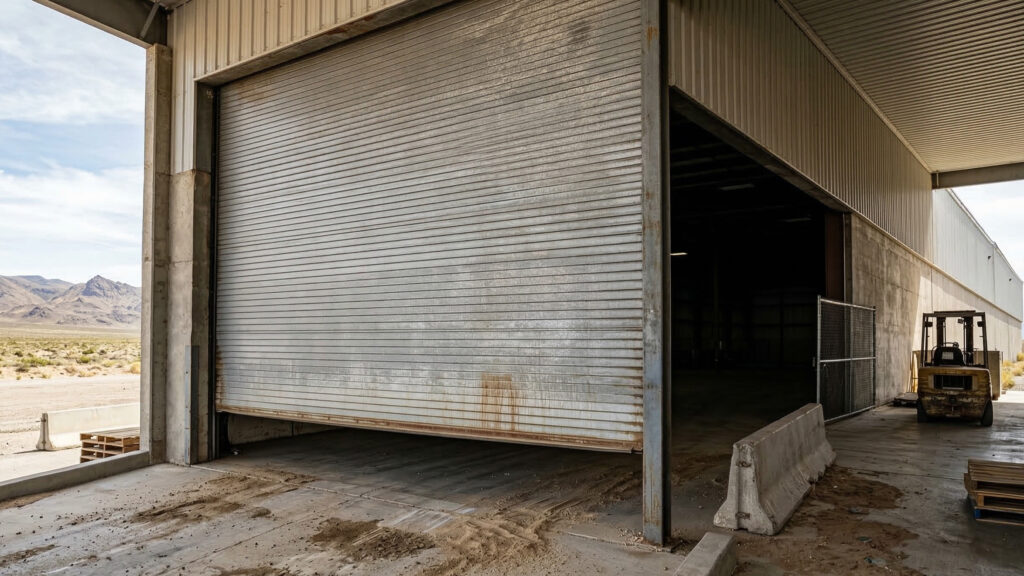
In the high-stakes world of facility management, the commercial overhead door is often the most overlooked piece of heavy machinery in the building. It hangs there, massive and silent, until the moment it fails—usually at the worst possible time. For businesses across Nevada, from the high-desert warehouses of Reno to the bustling loading docks of Las Vegas, the transition from winter to spring is the most critical window for maintaining these assets.
Winter in the Silver State is a brutal cycle of extremes. We deal with the “freeze-thaw” effect, where moisture seeps into hardware during the day and expands as ice at night. We deal with the aggressive chemical onslaught of road salts and ice melt tracked in by fleet vehicles. And as the winds pick up in the spring, that moisture turns into a grinding paste of desert dust and sludge.
This guide is designed to help facility managers and building owners in Nevada execute a post-winter recovery plan. By cleaning and inspecting your door hardware now, you prevent the corrosion and misalignment that lead to costly emergency repairs and operational downtime.
The Winter Hangover: How Debris Destroys Hardware
Before picking up a bucket and brush, it is vital to understand exactly what happened to your doors over the last few months. Commercial doors are precision-engineered systems. When foreign contaminants enter the equation, the physics of the door begins to change.
1. The Chemical Attack (Corrosion)
Road salt and liquid de-icers are hygroscopic—they pull moisture out of the air. When these chemicals sit on galvanized steel tracks, zinc-plated hinges, or high-tensile springs, they trigger an electrochemical reaction. This leads to “white rust” (zinc oxidation) and eventually red rust, which eats into the structural integrity of the steel.
2. The Grinding Paste (Track Misalignment and Roller Wear)
In the desert, winter “sludge” is a mix of melted snow, oil, and fine silica dust. This mixture finds its way into the tracks and the bearings of your rollers. Instead of rolling smoothly, the rollers begin to slide or “skid” through the debris. This flat-spots the rollers and puts immense lateral pressure on the tracks, eventually pulling them out of alignment.
3. Weatherstripping Degradation
Ice melt chemicals are notoriously hard on rubber and PVC. Over the winter, your bottom seals and jamb seals have likely become brittle or “glued” to the ground by frozen slush. Attempting to operate a door with frozen seals can strip operator gears or tear the weatherstripping away, leaving your facility vulnerable to the encroaching desert heat.
Step-by-Step Post-Winter Cleaning Process
Cleaning a commercial door isn’t just about aesthetics; it’s about removing the “grit” from the gears. Follow this professional workflow to ensure your doors survive the transition into the dry, hot months.
Step 1: The Preliminary Clear-Out
Start by sweeping the floor area around the door, both inside and out. If you spray the door before sweeping, you’ll simply create more mud that splashes back onto the hardware. Pay special attention to the threshold where the bottom seal meets the concrete.
Step 2: Cleaning the Door Panels
Whether you have Sectional Steel Doors, Rolling Steel Doors, or High-Speed Doors, the face of the door needs a wash.
- For Steel: Use a soft-bristled brush and a mild, biodegradable detergent (avoid anything with bleach or harsh acids). Rinse from the top down.
- For High-Speed Fabric Doors: Check the manufacturer’s specs, but generally, a damp cloth with mild soap is sufficient. Avoid high-pressure washers, which can force water into the motor housing or electronics.
Step 3: Scouring the Tracks
The tracks are the “highway” of your door. If the highway is covered in glass and gravel, the tires (rollers) will pop.
- The Method: Use a vacuum to suck out dry debris from the “V” or “U” of the track.
- The Deep Clean: Use a degreaser on a rag to wipe down the internal track surfaces. You want the metal to be smooth to the touch.
- Crucial Note: Do not lubricate the inside of the tracks. Grease in a Nevada environment acts as a magnet for desert dust, creating a thick, abrasive sludge that will seize the door.
Step 4: Detailing the Roller Assemblies and Hinges
Inspect each roller. The wheel should spin freely on the stem. If the roller is wobbly or the bearings are grinding, it’s time for a replacement. Wipe away any visible clumps of grease and dirt from the hinges. Once clean, apply a penetrating silicone-based or synthetic lubricant to the moving parts—never use WD-40 for lubrication (it’s a solvent, not a lubricant).
Step 5: Weatherstripping and Seals
Wipe down the perimeter seals. Look for cracks or areas where the rubber has become “tackified.” Applying a thin coat of silicone spray to the rubber seals can help prevent them from sticking to the door frame during the next cold snap or the upcoming summer heat.
Identifying Different Door Needs
Not all doors react to winter the same way. In Nevada, your specific door type dictates your maintenance focus:
- Rolling Steel Doors: These are particularly sensitive to “slat-lock.” If dust and salt build up between the interlocking slats, the door will become noisy and may eventually bind in the coil. Cleaning the curtain itself is vital.
- Sectional Doors: Focus on the hinges and the horizontal track. This is where most of the weight sits when the door is open, making it the prime spot for misalignment issues caused by debris.
- High-Speed Doors: These are built for cycles, often 50+ per day. The sensors (photo eyes or light curtains) are the primary failure point. A thin film of winter salt on a sensor lens will cause the door to “ghost” (reversing for no reason), halting your workflow.
Signs You Need Professional Intervention
While cleaning is a DIY task for many facility teams, some winter damage requires a certified technician. If you see these signs during your cleaning, calling a professional might be an option to resolve the issue:
Frayed Cables: If you see “bird-nesting” or single strands of wire sticking out from your lift cables, the door is a safety hazard. Corrosion from road salt often starts at the bottom of the cable where it attaches to the bracket.
Gaping or Uneven Hanging: If the door is not level when closed, your springs have likely lost tension or a cable has stretched. This puts an uneven load on the motor.
The “Screech” or “Grind”: If a thorough cleaning and lubrication don’t silence the door, the bearings in the rollers or the end-bearing plates are likely shot.
Visible Rust on Springs: Never attempt to clean or touch the springs. If you see red rust on the torsion springs, they are at risk of snapping. A rusted spring has increased friction between the coils, which fatigues the metal much faster than a clean, lubricated one.
Slow Cycle Speeds: If a high-performance door or automated gate is moving slower than its rated speed, the motor is likely fighting friction from fouled hardware.
The Nevada Context: Transitioning to the Heat
In Nevada, we don’t just have a winter problem; we have a “transition” problem. As the humidity drops and the temperature climbs toward 100°F, the moisture that kept winter sludge “soft” evaporates. That sludge becomes as hard as concrete. If you don’t remove that debris in the spring, it will bake onto your hardware, leading to a summer of “Overload” errors on your operators and burned-out motors.
Furthermore, the dry Nevada wind acts like a sandblaster. Any exposed metal that lost its protective coating to winter salt will now be subjected to abrasive dust. Proper cleaning followed by a professional inspection ensures that your doors are “sealed” and ready for the thermal expansion that comes with desert summers.
Cleaning your doors is the first step toward facility health, but it isn’t the last. A professional tune-up goes beyond the surface, involving high-tension adjustments, safety sensor calibration, and structural integrity checks that keep your business moving safely.
Don’t wait for a spring storm or a summer heatwave to find the weak points in your overhead doors. Contact Nevada Overhead today to schedule a comprehensive post-winter maintenance visit. Our technicians serve the entire Nevada region, ensuring your steel, tracks, and motors are ready for whatever the desert throws at them next.
Keep your steel strong and your facility secure. Call Nevada Overhead for a professional inspection today.